 跳到内容
跳到内容 
A rough surface inside a sanitary fitting can become a hidden source of contamination, corrosion, and inefficiency. Many process failures begin where the eye cannot see — the inner surface of your valve or pipe.
Surface roughness, expressed as Ra value, defines how smooth a sanitary fitting is. The lower the Ra, the smoother the surface — reducing bacterial adhesion, improving cleanability, and ensuring process safety and consistency.
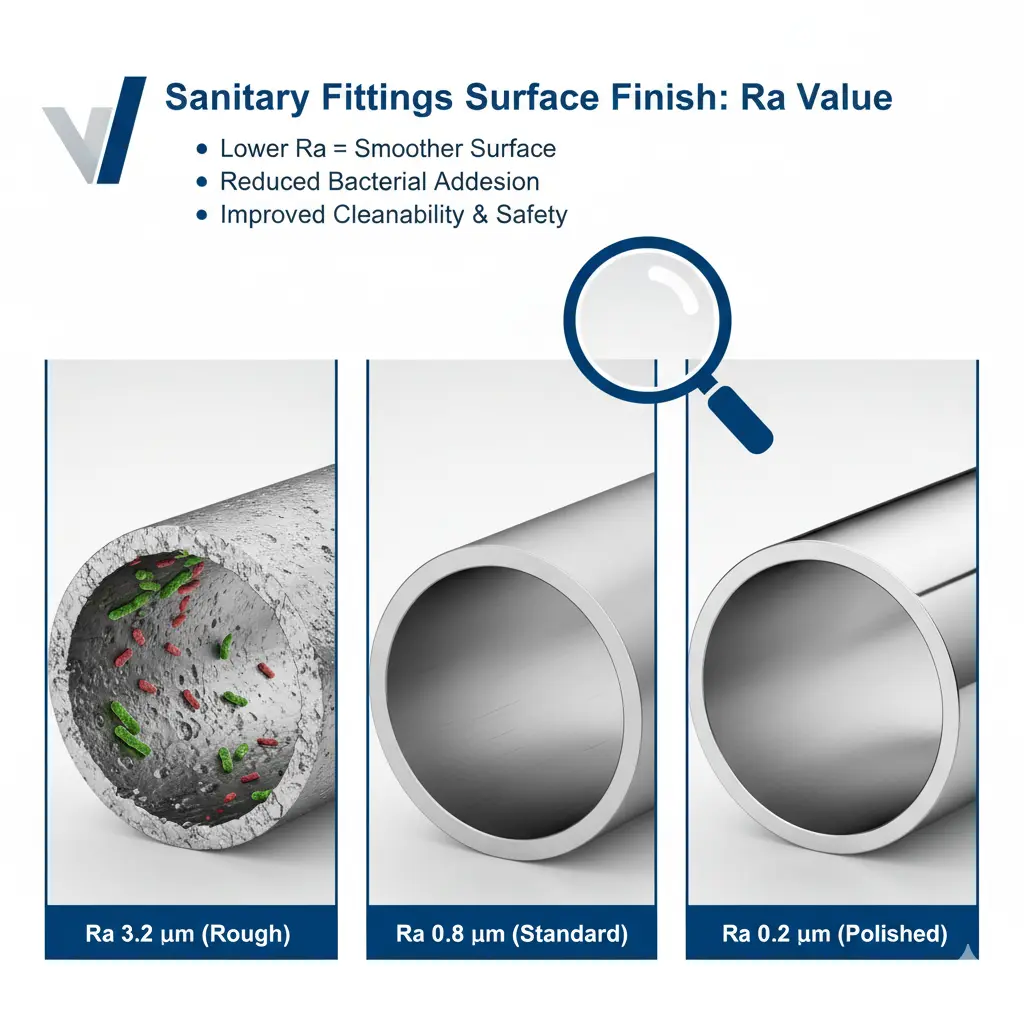
When I first started working with sanitary fittings, I thought material quality mattered most. Over time, I realized surface finish can be the silent difference between a system that works flawlessly and one that fails under inspection. Understanding Ra values helps prevent contamination, reduces cleaning cycles, and ensures compliance with hygiene standards in industries like food, beverage, and pharmaceuticals.
What Does Ra Value Really Mean in Sanitary Fittings?
Most people see “Ra” mentioned in product datasheets but don’t know what it really means. It’s more than a number — it’s a direct measure of cleanliness, performance, and compliance.
Ra (Roughness Average) measures the average microscopic peaks and valleys on a surface. In sanitary fittings, a lower Ra means a smoother surface, which helps prevent residue build-up and bacterial growth.
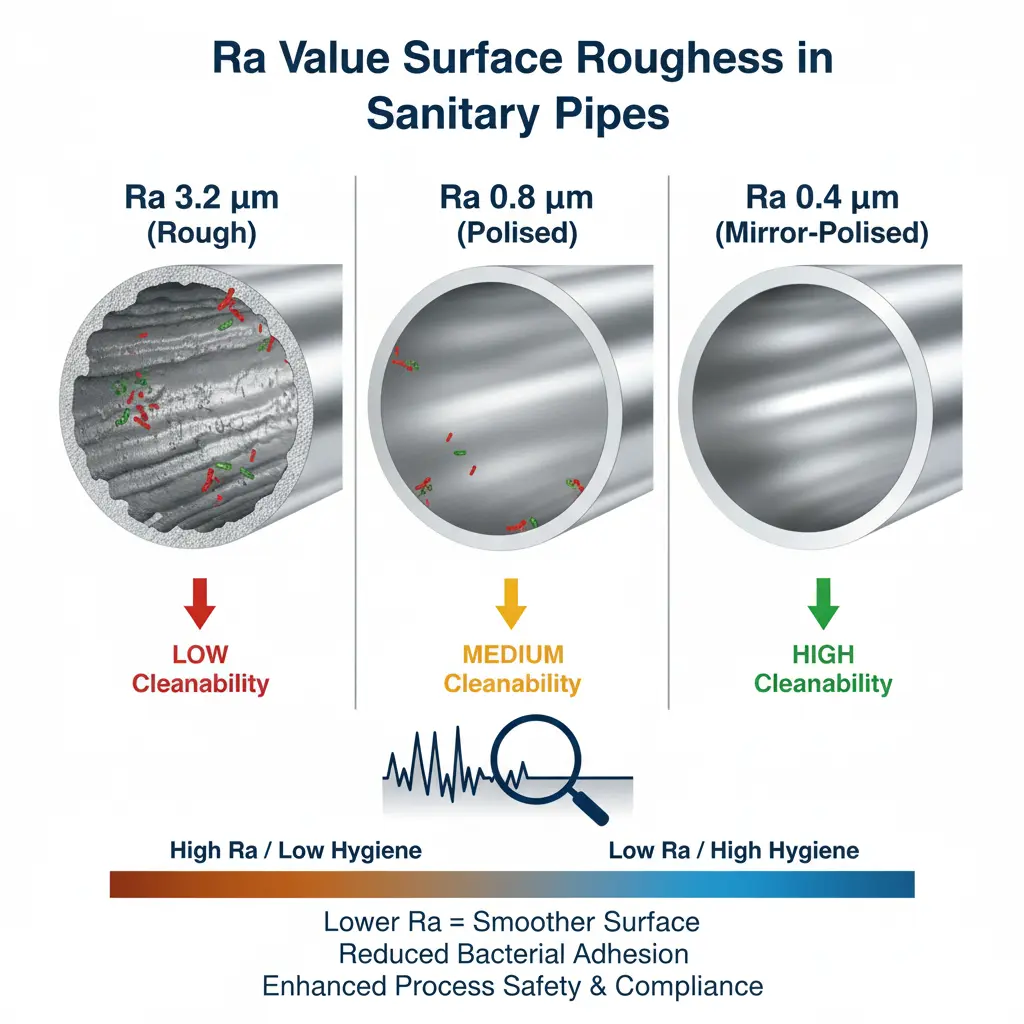
Understanding Surface Roughness and Its Impact
Let’s break it down clearly:
| Ra Value (µm) | Typical Application Area | Surface Description | Hygiene Level |
|---|---|---|---|
| 3.2 – 1.6 | Industrial piping, water | Rough, visible lines | Low |
| 0.8 – 0.4 | Food and beverage lines | Polished, smooth | High |
| 0.4 – 0.25 | Pharmaceutical, biotech | Mirror-like, ultra-smooth | Very high |
When a fitting has a high Ra value, cleaning agents cannot fully reach into the micro-valleys, leaving traces of residue or bacteria. This small detail can cause contamination over time. On the other hand, a properly polished fitting — say with Ra ≤ 0.4 µm — offers a clean, reflective surface that resists adhesion and allows quick rinsing.
I learned this lesson while supplying valves to a dairy plant years ago. They were facing recurring microbial contamination despite frequent cleaning. The problem turned out to be fittings with Ra above 0.8 µm. Once we switched them to 0.4 µm mirror-polished ones, the contamination disappeared. It was a powerful reminder that cleanliness starts with surface quality.
Why Is Surface Finish Critical in Hygienic Applications?
It’s easy to overlook surface finish when you’re focused on specifications like pressure rating or material type. But in sanitary systems, smoothness can be as important as stainless steel grade.
In hygienic processing, a smoother Ra finish ensures proper clean-in-place (CIP) and sterilize-in-place (SIP) performance, minimizing bacterial risk and improving system lifespan.

Dive Deeper: The Role of Ra in Hygiene and Maintenance
Let’s analyze what happens during actual operations:
1. Cleanability
The smoother the surface, the less likely residue adheres. A mirror-polished 316L fitting with Ra ≤ 0.4 µm cleans faster, requiring less detergent and time. This saves both water and energy.
2. Contamination Prevention
Bacteria prefer rough surfaces. Microscopic crevices act as hiding spots. A lower Ra surface eliminates these zones, meeting FDA and 3-A Sanitary Standards that demand non-porous contact surfaces.
3. Corrosion Resistance
Polishing reduces surface defects that can act as corrosion initiation sites. In industries using acidic or saline solutions, a low Ra value extends product life.
4. Regulatory Compliance
Different industries demand different Ra ranges. For example:
- Food & Beverage: typically Ra ≤ 0.8 µm
- Pharmaceuticals: Ra ≤ 0.5 µm
- Biotech: Ra ≤ 0.25 µm
When BYZER supplies sanitary valves, we always verify Ra through precision surface roughness testing instruments and offer detailed inspection reports. This transparency reassures clients that what they receive is compliant and safe to use immediately.
How Is Ra Value Achieved and Measured?
Not every “stainless” fitting is truly hygienic. The production process determines whether the surface is just visually shiny or genuinely smooth at a microscopic level.
Ra value is achieved through controlled mechanical and electrochemical polishing processes, and verified using contact or optical surface roughness testers.
Dive Deeper: From Raw Steel to Mirror Finish
Here’s how a sanitary fitting achieves its target Ra:
Step 1: Initial Machining
After CNC machining, the surface roughness usually ranges between Ra 3.2 – 1.6 µm. It’s functional but far from sanitary-grade.
Step 2: Mechanical Polishing
A series of polishing operations using abrasive compounds gradually reduce roughness. The process can bring Ra down to 0.8 µm or lower.
Step 3: Electropolishing (Optional)
This step uses an electrochemical process to remove microscopic peaks and smooth out the surface further. It also improves corrosion resistance and produces a bright, chrome-like appearance.
Step 4: Inspection and Testing
Finally, Ra is measured using a profilometer. For high-purity industries, every fitting batch is tested and logged. At BYZER, we provide Ra inspection reports upon request, especially for pharmaceutical clients who require traceability.
The attention to detail here is what sets apart standard fittings from hygienic-grade components. I often remind clients that even the smallest scratch can change the Ra and compromise hygiene — which is why packaging and handling are just as important after polishing.
Choosing the Right Surface Finish for Your Process
Many procurement managers struggle to decide which Ra level is best for their projects. Choosing the wrong one can lead to over-specification (and higher costs) or under-specification (and contamination risks).
The right Ra value depends on your industry, cleaning process, and risk tolerance. It’s about finding a balance between performance, compliance, and cost efficiency.
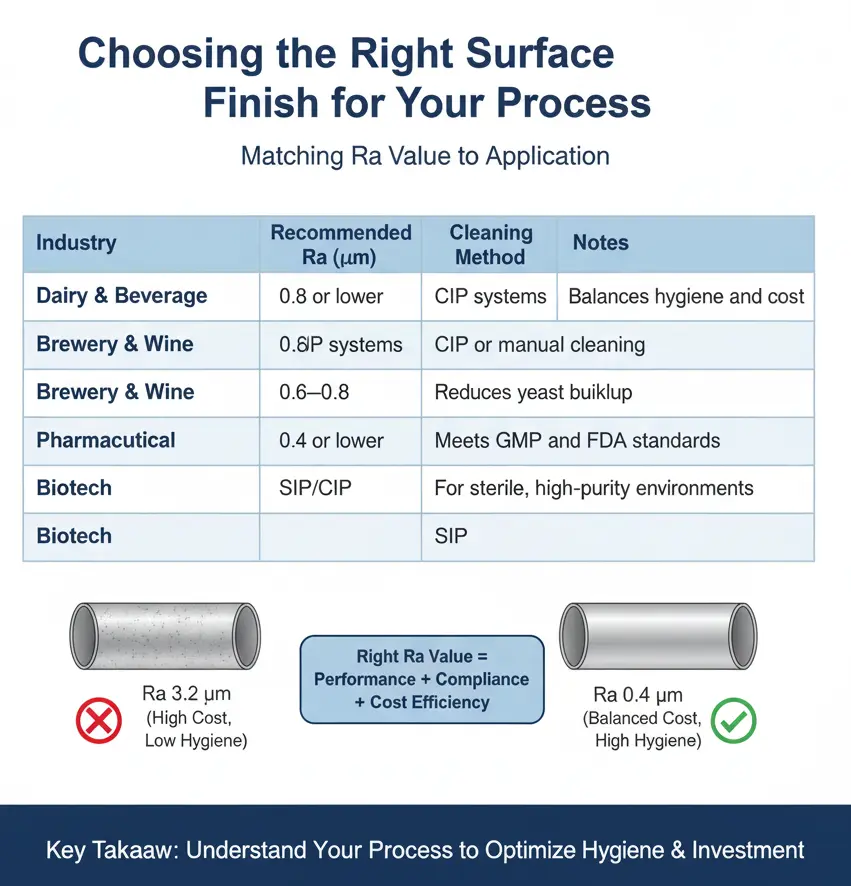
Dive Deeper: Matching Ra Value to Application
| Industry | Recommended Ra (µm) | Cleaning Method | Notes |
|---|---|---|---|
| Dairy & Beverage | 0.8 or lower | CIP systems | Balances hygiene and cost |
| Brewery & Wine | 0.6–0.8 | CIP or manual cleaning | Reduces yeast buildup |
| Pharmaceutical | 0.4 or lower | SIP/CIP | Meets GMP and FDA standards |
| Biotech | 0.25 or lower | SIP | For sterile, high-purity environments |
From my experience, clients in food and beverage sometimes overspend on electropolished 0.25 µm surfaces when 0.8 µm would fully meet their hygiene needs. Conversely, pharmaceutical plants sometimes underestimate the need for electropolishing and end up with cleaning inefficiencies. The key is understanding your process flow, temperature range, and cleaning frequency before deciding.
At BYZER, our engineering team helps customers match valve and fitting Ra levels precisely to their use cases, avoiding unnecessary costs while ensuring full compliance with hygiene standards.
Conclusion
Surface finish defines the real hygiene and performance of sanitary fittings. Understanding and specifying the correct Ra value ensures cleaner processes, longer equipment life, and full compliance with global sanitary standards.
